A National Coming Out Day message about building a gayborhood for life.
By Randy Downs, co-owner of Protest Pizza + Bar
You don’t have to come out to come in.
In 2011, I moved from rural Missouri to Washington, DC, for a job with the Sierra Club supporting student and youth organizing.
I also knew where I wanted to build my life: Dupont Circle.
I wanted to live openly and fully as a gay man in a way I didn’t feel I could back home. Dupont—DC’s gayborhood—represented possibility. It was somewhere I could find my people and imagine a future for myself.
Today, Ricky and I run Protest Pizza + Bar, our queer-owned neighborhood pizza shop and bar on P Street.
Protest is a business, but it is also how Ricky and I choose to show up for this neighborhood. We want to help strengthen the kind of community we want to live in: proudly queer, welcoming to families, supportive of young people, connected across generations, and a place where our elders continue to live full lives.
That feels especially important on National Coming Out Day.
National Coming Out Day was first observed in 1988, on the first anniversary of the October 11, 1987 National March on Washington for Lesbian and Gay Rights. Its roots are right here in Washington, DC.
Coming out is deeply personal. Whether, when, and how someone shares their identity belongs to them.
But what happens around that person is a community responsibility.
Coming out is personal. Belonging is something we build together—and it should last a lifetime.
A gayborhood takes work
Dupont’s identity didn’t happen by accident, and it doesn’t maintain itself automatically.
My neighborhood work over the years has included the rainbow crosswalks and boulevard banners, the High Heel Race, the 17th Street Pride Block Party, Friends of Stead Park, and now Protest Pizza.
Those things matter because neighborhood identity takes people willing to show up.
The rainbows matter. The celebrations matter. So does everyday life between them.
I’ll admit something: in my younger days in Dupont, I sometimes did a double take at all the strollers.
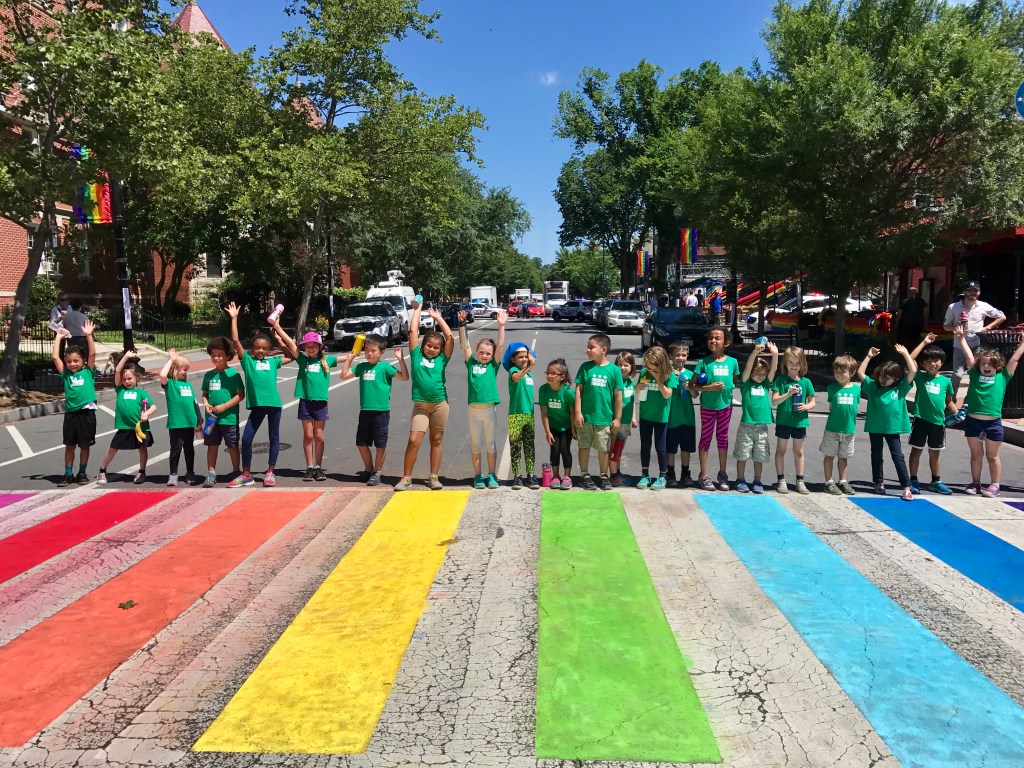
I think about a photo I took at 17th and Church on June 25, 2019. A class of Ross school kids was crossing the street over the temporary rainbow crosswalk, before the permanent rainbow bands we know today were installed. I asked if I could take a picture.
Looking at it now, it feels like a pretty good picture of the neighborhood I want us to keep building: kids growing up right in the middle of the gayborhood, with all of its history, color, and community around them.
These days, I cherish seeing kids grow up here.
Kids aren’t making Dupont less queer. They’re part of the future of the gayborhood.
And honestly, what better place to grow up?
A child here can know families with two moms, two dads, one parent, grandparents, chosen family, and every configuration in between. They can see LGBTQ+ adults running businesses, making art, raising kids, organizing their neighborhood, falling in love, and simply living their lives.
But rainbow crosswalks alone don’t create a support system.
We have to be one.
Growing up and finding your people
For our youngest neighbors—families at Ross and Garrison, kids running around Stead Park, and elementary-age children throughout DC—belonging can begin with something simple: seeing their family treated like every other family.
As kids grow, the needs change.
Middle-school students at John Francis Education Campus, formerly School Without Walls at Francis-Stevens, high-school students at Cardozo and elsewhere in DC, and teenagers across the neighborhood need adults who listen, take bullying seriously, and respect their privacy.
A teenager should hear an adult interrupt a cruel joke rather than laugh along. Someone questioning who they are deserves room to think without being pressed for an answer.
This isn’t a request for kids to come out. It’s a request for adults to be people they can trust.
That matters even if your own child isn’t LGBTQ+.LGBTQ+ Elders
Your child may be the friend someone chooses to come out to. They should know what kindness, privacy, and standing up for someone look like.
Teenagers also need positive places to find their people.
GenOUT Youth Chorus, part of the Gay Men’s Chorus of Washington, DC, welcomes LGBTQ+ and allied singers ages 13–18. There is no audition, and scholarships are available. Here in the neighborhood, GenOUT rehearses at St. Thomas’ Parish alongside the broader GMCW community.
Know a teenager who loves to sing? Tell them about GenOUT.
And then do something equally important: show up for them.
Go to their concerts. Applaud loudly. Let young people see adults investing time in what they create.
Support shouldn’t stop at 18, either.
Young adults arriving in DC, starting college, beginning careers, or simply trying to make friends need ways to find community too—especially ways that don’t always depend on nightlife or spending a lot of money.
I remember arriving here and looking for my people.
Plenty of people are still doing that today.
You shouldn’t age out of the gayborhood
The future we want young people to imagine is the life our elders deserve to enjoy right now.
Older LGBTQ+ neighbors deserve friends. Dates. Dinner plans. Activities they actually want to attend. New relationships and new experiences.
They deserve other LGBTQ+ people around them as friends, neighbors, partners, and peers—not only as reminders of our history.
You shouldn’t age out of the gayborhood.
That means thinking seriously about affordability and accessibility, too.
A neighborhood can’t call itself welcoming if the people who helped build its community can no longer afford to remain part of it.
One of my longer-term dreams is an LGBTQ+-affirming living community for older adults here in Dupont, with affordability, dignity, independence, and connection at its heart.
That is a dream, not an announced project.
But the principle matters now: our elders belong in Dupont’s future, not just its history.
Dupont Circle Village already shows one way to keep those connections strong. Its LGBTQ+ & Friends gatherings at Protest bring neighbors together for food, conversation, and the simple pleasure of having plans with other people.
That may sound small.
It isn’t.
A strong community is built out of people actually knowing one another.
Building the neighborhood we want
That brings me back to Stead Park.
Through my work with Friends of Stead Park, I increasingly see the park as an opportunity for something bigger: an intergenerational center of neighborhood life.
Children and families should remain at its heart. But imagine more opportunities where generations are there together.
More frequent community movie nights. Teen and family silent discos. Games. Art. Performances. Neighborhood gatherings.
Little kids get to be little kids.
Middle-schoolers and teenagers get activities that actually interest them.
Young adults have a reason to participate.
Parents meet one another.
Older neighbors feel like the invitation includes them, too.
Not every gathering needs to teach a lesson about identity. Sometimes the best community-building is watching a movie together, laughing at the same thing, and recognizing each other the next time you’re walking down P Street.
That’s how strangers become neighbors.
That intergenerational connection is also why Leigh Mosley’s photographs hang on the walls at Protest.
Leigh documented LGBTQ+ activism in Washington, including the first National March on Washington for Lesbian and Gay Rights in 1979. Her photographs bring that history into an everyday neighborhood pizza shop.
A teenager can notice one while eating a slice. Someone who remembers those years might recognize the moment. A conversation can start.
And then everyone can go back to eating pizza.
That’s the point.
We also hope to bring a screening of Leigh’s documentary project, Pioneers for Justice: Black Lesbians in the DMV, to Stead Park. It isn’t scheduled yet, but it’s exactly the kind of gathering we want to help create.
History. Art. Young people. Elders. Neighbors. Public space.
Together.
What Protest can do
We don’t pretend a pizza shop can solve housing affordability, youth isolation, or every challenge facing LGBTQ+ people.
But neighborhood businesses help shape neighborhoods.
At Protest, we can support school and family events. We can welcome Dupont Circle Village. We can promote GenOUT. We can put Leigh Mosley’s work on our walls. We can sponsor Little Goblins. We can help bring neighbors together through events like Howl-O-Ween.
We can give a family somewhere to stop after Stead, an older neighbor somewhere to meet a friend, a team somewhere to gather after a game, and someone new to DC somewhere they begin recognizing familiar faces.
Sometimes community infrastructure looks like a recreation center or affordable housing.
Sometimes it looks like a pizza shop.
And sometimes you should just be able to walk in and get a good slice.
You don’t have to come out to come in.
You don’t owe us a label or a personal story. You don’t have to be LGBTQ+.
You do have to respect the people around you.
Everyone is welcome. Fascism, bigotry, bullying, and harassment aren’t.
Put it into practice
National Coming Out Day shouldn’t end with a supportive post.
Here are three ways to make the welcome real.
1. Be someone people can trust.
If someone comes out to you, listen. Respect their privacy. Keep including them.
Parents and caregivers don’t need to have every answer. Metro DC PFLAG and SMYAL offer support and places to learn.
2. Help someone find their people.
Tell a teenager about GenOUT.
Invite an older neighbor to lunch.
Check on the young adult who just moved to DC.
Introduce two people you think should know one another.
3. Show up.
Neighborhood identity is built through participation—not just appreciation.
And Saturday, October 24 gives us plenty of opportunities.
Little Goblins Parade
Gather at Ross Elementary at 12:30 p.m. The parade steps off at 12:45, trick-or-treats along 17th Street, and continues with games, music, crafts, and fun at Stead Park until 3 p.m. Protest is proud to be a sponsor.
Howl-O-Ween Block Party
Join us from 1–7 p.m. at Church and 17th Streets, beside Stead Park, for pet fashion shows, live music, drag, DJs, food, and plenty of neighborhood characters—human and otherwise.
GMCW’s Heated Revelry at Keegan Theatre
Support queer artists right here on Church Street, with performances at 2, 5, and 8 p.m. The 2 p.m. performance includes ASL interpretation. Complimentary tickets are available for schools, LGBTQ+ student groups, youth-based nonprofits, and people experiencing financial hardship; requests must be received at least one week before the performance.
Pick something. Invite somebody. Put it on the calendar.
Then do it again next month.
A gayborhood for life
I came to Dupont looking for a place where I could build a full, authentic life.
Fifteen years later, I still believe deeply in that promise.
But now I understand it differently.
A strong gayborhood isn’t only a place where someone can come out.
It’s a place where they can grow up, find their people, fall in love, build a family—or not—start a career, make friends, grow older, stay connected, and keep living fully.
That is the neighborhood Ricky and I want to live in.
And that is the neighborhood we want Protest to actively help strengthen.
Celebrate being yourself. Help someone find their people. Keep showing up.
That’s our National Coming Out Day message.
You belong here. At every age.
That’s a gayborhood for life.


Leave a Reply